
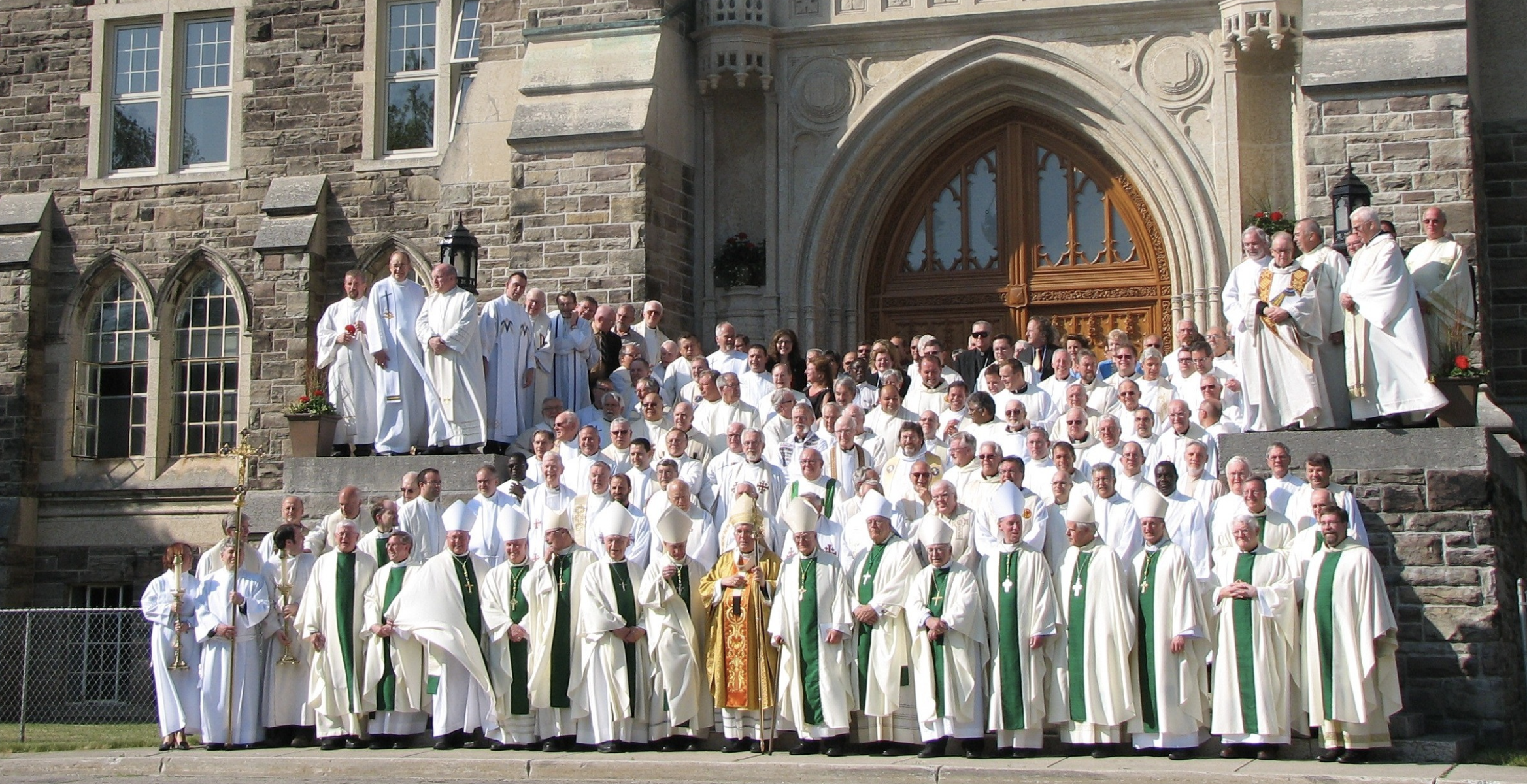
One building. Thousands of lives. A century of service to the Church, from the current site of St. Peter’s Seminary, built in 1926.
In September 1926, a magnificent new building rose along the Thames River in London, Ontario. Constructed from Credit Valley stone on 25 acres of land generously donated by Sir Philip Pocock, St. Peter’s Seminary was formally opened on September 29, 1926, as part of a remarkable week of celebration for London’s Catholic community. Bishop Michael Francis Fallon presided over the opening, marking the culmination of a vision that had begun more than a decade earlier. This September, that building celebrates its 100th anniversary.
But a century of St. Peter’s is about far more than stone, architecture and history. It is about people.
It is about the men who answered the call to the priesthood, the lay women and men who prepared for ministry, the faculty who formed them, the benefactors who sustained them, and the countless people whose lives have been touched by their service.
A Vision That Began in 1912
St. Peter’s Seminary was founded in 1912 by Bishop Michael Francis Fallon, who believed the Church in southwestern Ontario needed a place where future priests could be formed near the people and communities they would one day serve.
In its early years, the Seminary operated out of the Bishop’s residence beside St. Peter’s Cathedral. The First World War delayed construction of a permanent home, yet Bishop Fallon’s vision endured.
In 1925, the cornerstone of the present Seminary building was laid. Just over a year later, the doors opened.
The building was designed in the Collegiate Gothic tradition and intended to be much more than a place to live and study. It was conceived as a community dedicated to prayer, intellectual formation, human development, and preparation for ministry.
Four years later, the Chapel of St. Thomas Aquinas was completed, adding another sacred dimension to the campus. Its 125-foot nave and exceptional craftsmanship have made it a defining feature of St. Peter’s.
And so began a century in which generations of students would walk its corridors, study in its classrooms, pray in its chapel, discern their vocations, and prepare to serve God's people.
A Century of Lives Changed
The true significance of St. Peter’s legacy lies not in its building’s age but in what has occurred inside. Since its inception, over 1,000 students have been ordained, serving in over 50 dioceses and religious communities across Canada, the U.S., and elsewhere. Its alumni include 20 bishops, and about 122 lay graduates from the theological program have also served the Church in different roles.
And the story continues.
Today, St. Peter’s welcomes seminarians from across Canada and around the world, while also educating lay women and men for lay ministry and for the men preparing for the permanent diaconate. Formation is not only about preparing priests and lay people to serve, but also about the impact that extends far beyond the Seminary.
One Formation. Many Ways to Serve.
One person's formation can touch hundreds or even thousands of lives. Those formed at St. Peter's Seminary carry their education, faith and formation into the places where people live, work, learn, worship and seek support. Priests and lay graduates have distinct vocations and responsibilities within the Church, yet they share a common call: to accompany others, to serve with compassion, and to help build communities of faith and hope.
Priests are entrusted with the Church’s sacramental and pastoral ministry—celebrating the Eucharist, baptizing children, witnessing marriages, accompanying families through illness and grief, presiding at funerals, teaching, visiting the sick and those who are alone, and being present to people at the most significant moments of their lives.
Lay graduates bring their gifts, professional expertise and vocation to the same mission. They serve and lead in parishes, schools, hospitals, universities, social service agencies and diocesan ministries. They may be educators, therapists, caregivers, administrators, pastoral ministers, advocates, parents and community leaders. In each of these settings, they apply their formation to their relationships with the people and communities they serve.
Different vocations. Different responsibilities. One mission.
Together, priests and lay women and men help the Church become what it is called to be: a community that accompanies people, proclaims the Gospel, cares for those in need, and brings Christ's presence into the world.
The impact of St. Peter's cannot be measured simply by the number of priests ordained or graduates who have completed a program. It is measured by the people they accompany, the communities they strengthen, the lives they touch, and the hope they bring. That is the enduring impact of formation at St. Peter's.
Multiply that across a century, across generations, and across communities—and the true impact of St. Peter's begins to come into view.
The Church Beyond the Walls
For 100 years, the Seminary has been a place where the Church prepares for its future. Its graduates have carried the formation they received at St. Peter's into parishes, classrooms, hospitals, boardrooms, homes and communities. They have served close to home and around the world:
They have taught.
They have preached.
They have accompanied.
They have led.
They have comforted.
They have built communities of faith.
And they have helped the Church respond to changing times while remaining rooted in the Gospel.
The building itself has witnessed a century of change, from the Depression and the Second World War to Vatican II and the profound societal and ecclesiastical changes that followed. Through it all, St. Peter's has remained a place of discernment, formation and service.
A Legacy Built by Many Hands
No institution reaches its 100th anniversary alone. The Seminary's story has been written by bishops and rectors, priests and religious, professors and staff, seminarians and lay students, alumni and, perhaps most importantly, the generations of people who believed that formation was worth investing in.
Every prayer prayed.
Every scholarship provided.
Every classroom maintained.
Every book added to the library.
Every vocation supported.
Every opportunity for formation made possible.
Every gift given in faith has helped build this legacy.
The stone walls may have been laid in 1925 and 1926, but the living foundation of St. Peter's has been built over 100 years by people who believed in the future of the Church.
And Now, the Next 100 Years
A centennial is both a celebration and an invitation. We look back with gratitude for what God has accomplished through St. Peter's Seminary. But we also look forward.
The Church continues to need faithful priests. It needs deacons, lay ministers, teachers, pastoral leaders and women and men equipped to bring the Gospel into an increasingly complex world.
The next chapter of St. Peter's will be written by those who answer that call and by those who choose to stand behind them.
100 years ago, people built a Seminary.
For 100 years, the Seminary has formed people who have helped build the Church.
Today, the St. Peter's Seminary Foundation exists to help ensure that this extraordinary legacy continues.
The building has stood for a century.
The mission must continue for generations to come.
Help build the next 100 years.