
For generations, the magnolia trees that grace the grounds of St. Peter’s Seminary have been among the earliest signs of spring and among the most welcoming sights for those arriving at the Seminary.
Their magnificent pink blossoms have greeted generations of seminarians, faculty, staff, alumni, and visitors, offering a radiant reminder that renewal follows every winter.
This year, a new magnolia has taken root at St. Peter’s Seminary, carrying a very special meaning.
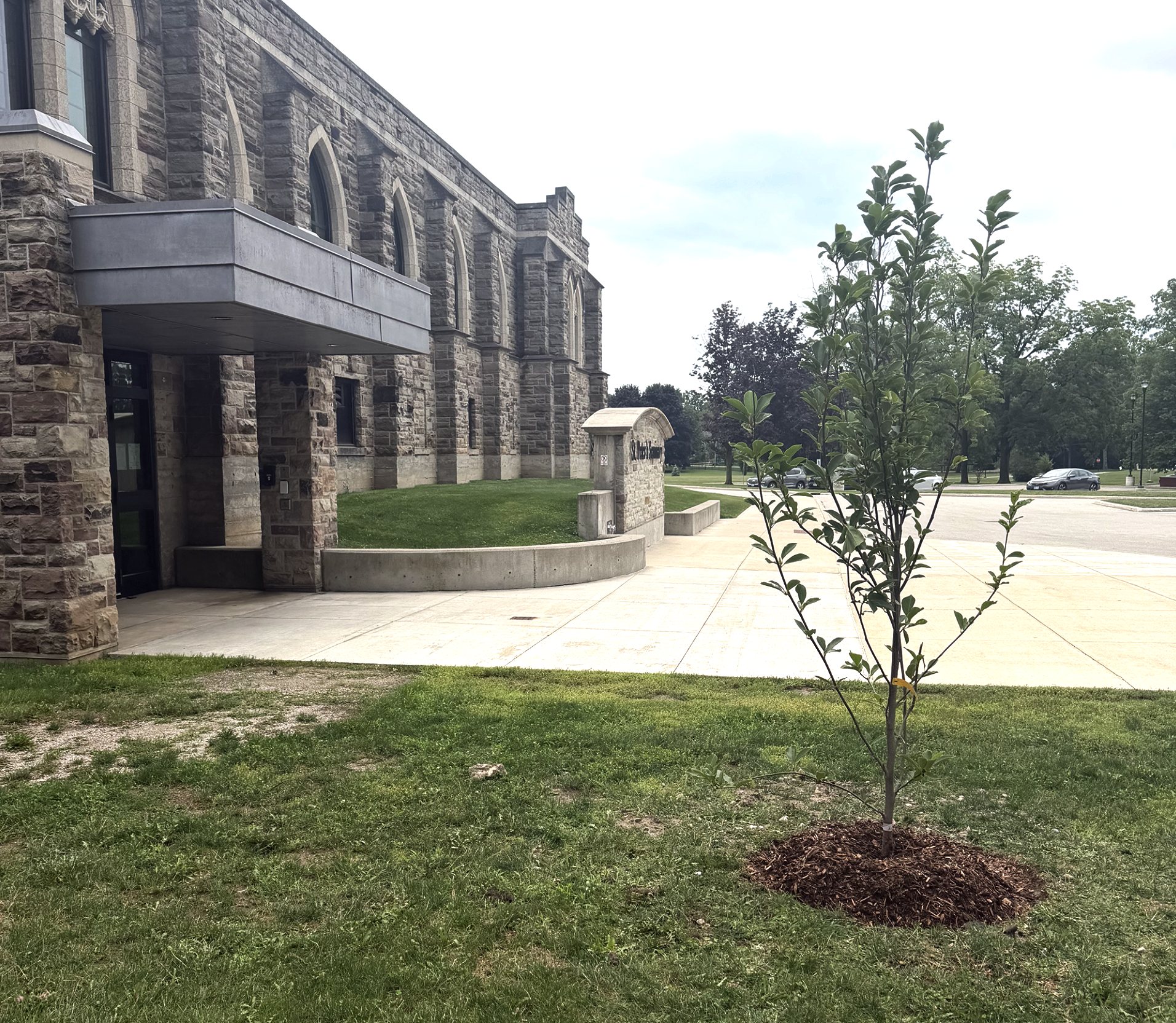
On August 7, 2026, a magnolia tree was planted at the entrance to the Seminary’s newer west-side addition, a fitting tribute as St. Peter’s prepares to mark the 100th anniversary of its historic building this September and to welcome alumni back for its triennial reunion.
The new tree was inspired by longtime alumnus Father Terrence McNamara, who saw an opportunity to connect the Seminary’s past, present and future through something both simple and enduring.
Father McNamara is dedicating the tree to all St. Peter’s Seminary alumni in honour of his family.
A living symbol of welcome
Magnolias hold a remarkable place in the story of St. Peter’s.
For decades, the mature trees surrounding the Seminary have grown alongside the institution. They have witnessed countless arrivals and departures: young men beginning their formation, newly ordained priests returning to visit, faculty and staff starting their work, families gathering for celebrations, and generations of alumni coming home.
They have also welcomed the many lay students who have passed through St. Peter’s classrooms—men and women whose formation here has prepared them to bring their faith and ministry into hospitals, schools, classrooms, parishes, homes, and communities throughout the region and beyond.
The new magnolia will now take its place among them. Planted at the entrance to the Seminary’s modern addition, the tree also symbolizes the ongoing story of St. Peter’s.
The historic building has witnessed a century of change. Carefully maintained over the years, it has also been renewed and expanded to meet the needs of a changing Church and a changing world. Most recently, a major capital renovation added a new west-side entrance and a new wing with modern classrooms, offices, and meeting spaces. The seminarian wing was also renovated, providing new suites for those currently discerning and preparing for the priesthood.
The new magnolia stands at the threshold between two realities: the heritage we have received and the future we are building.
Rooted in the past. Growing toward the future.
There is something particularly appropriate about choosing a tree to mark a centennial.
A tree does not simply commemorate the past. It grows.
Its roots reach deep into the soil, while its branches extend outward and upward.
Each season adds another ring of growth, quietly recording the passage of time.
In much the same way, the story of St. Peter’s Seminary has been built over generations.
The seminarians who studied here, the priests who served here, the lay students who received their formation here, the faculty who taught here, the staff who supported the Seminary, the benefactors who sustained it, and the families who encouraged vocations have all contributed to the institution that St. Peter’s is today.
The fruit of that formation has never remained confined to the Seminary’s walls. Priests formed at St. Peter’s have carried their ministry into parishes and communities. Lay students have taken their knowledge, faith and formation into hospitals, schools, classrooms and homes. In countless ways, the Seminary’s influence has extended far beyond its historic walls, touching lives wherever its students and alumni have been called to serve.
The magnolia is therefore more than a beautiful addition to the landscape. It is a living memorial to a century of people whose lives have been touched by St. Peter’s Seminary and who, in turn, have helped shape its history. Each spring, when it blooms, it offers a visible testament to that legacy.
A gift from one alumnus to many
Father McNamara’s decision to dedicate the tree to all alumni makes the gesture especially meaningful for this year’s centennial reunion.
Every alumnus carries his own memories of St. Peter’s: classrooms and the chapel, friendships and formation, challenging and joyful days, the people who influenced his vocation, and the experiences that shaped his life and ministry.
For some, that ministry has been lived out in the priesthood. For others, it has taken other forms of service to the Church and the wider community. Yet all are part of the story.
The magnolia will belong to all of them.
It will welcome returning alumni through the very entrance where today's Seminary community enters its future.
And in the years ahead, as its branches become more established and its spring blossoms more abundant, it will become another familiar landmark on the Seminary grounds, a reminder of those who came before and those who will come after.
A blossom for the next century
This September, St. Peter’s Seminary will celebrate 100 years since the opening of its historic building.
The celebration is an opportunity to look back with gratitude and to look forward with hope.
The new magnolia beautifully captures that spirit.
Its roots are planted in the ground today, but its greatest seasons lie ahead. Its first blossoms will come next spring, when it will offer the Seminary community a radiant welcome.
For generations to come, seminarians, lay students, faculty, staff, alumni, and visitors will pass beneath its branches.
Some will be preparing for the priesthood. Others will be preparing to serve the Church and their communities in their particular vocations. Still others will be returning to a place that helped shape who they became.
And perhaps they will pause to remember why it was planted.
To honour a family.
To honour generations of alumni.
To honour seminarians and lay students whose service advances the mission of St. Peter’s into the world.
To honour 100 years of St. Peter’s Seminary.
And to celebrate a future that continues to grow.
As St. Peter’s enters its second century in its current building, the new magnolia stands as a quiet but powerful symbol of what endures: faith, vocation, community, memory, and hope.